CHAPTER 4. ANALYSIS OF NOKIA’S STRATEGY
4.1 Background of Nokia5
Nokia was found in 1865 as a paper manufacturing company in southern
Finland. Then Nokia became a diverse conglomerate managing a wide
array of business from paper to chemicals and rubber. However, in
the late eighties Nokia went through a massive restructuring and
refocusing strategy, and divested eight businesses concentrating
solely on telecommunications known as Nokia Group in early nineties.
Nokia Group comprises two business groups: Nokia Networks and Nokia
Mobile Phones. In addition, Nokia includes a separate Nokia Venture
Organization and the corporate research unit, Nokia Research Center.
By adding mobility to the Internet, Nokia is endeavoring to offer
new opportunities for companies and has been dedicated to further
enriching the daily lives of the people. At the end of 2000, Nokia
with employees more than 60,000 people worldwide had production
lines in 10 countries on three continents, research and development
institutions in 15 countries on four continents, and sales to over
130 countries with a global network of distribution, sales, customer
services and other operational units (The Korea Times, 2001).
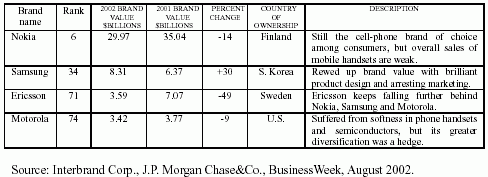
Furthermore, Nokia has also made a lot of progress in its brand
awareness all around the world. This has made the 6th most valuable
brand in the world with brand value of 29.97 billion dollars (see
Table 4-1).
Table 4-1: The Global Brand Scoreboard of Mobile
Phone Manufacturers.6
According to Gartner (Ananova, 2002), Nokia worldwide market share
grew to 35.9 percent in the third quarter of 2002. That is because
Nokia broke through the 50 percent market share in the Western European
market, as well as the larger Europe, Middle East and Africa regional
markets.
However, North America and Europe are nearing saturation levels
while the Asia-Pacific market volume is the highest of the three
geographic regions, surpassing both Europe and the Americas in 2002
(The Nation, 2002b). Asia-Pacific region is set to remain the driver
of growth for Nokia in order to ensure continued growth and maintain
the number one position in global mobile phone market. In addition,
Nokia is facing a lot of challenges in present day environment.
In 1990’s Nokia rode on the GSM technology and made a fortune out
of it but presently GSM is a comparative disadvantage with the onset
of 3G mobile phones. Therefore, Nokia is threatened by the emerging
of CDMA and other compatible systems supported 3G. Although Nokia
is working on W-CDMA, a wireless standard which is compatible with
3G phones, it has not manufactured a full-fledged 3G generation
device yet.
4.2 Nokia Korea
The history of Nokia in Korea extends back to 1984 when Nokia TMC
Company was established to manufacture mobile phones in Masan. Today,
Nokia TMC with more than 800 employees is the largest mobile phone
manufacturing site in Korea and one of Nokia's largest manufacturing
centers globally. At Nokia's Seoul office, about 140 staff works
at Nokia Mobile Phones, Nokia Networks, Nokia Internet Communications
and Nokia R&D. However, Nokia currently have only mobile phone
business in practice, and network equipment business is under pitching
for WCDMA.
For mobile phone commerce in Korean market, Nokia started its business
once in early 1990’s, but Nokia failed and had to retreat from this
market. Due to technological differences, Nokia sophisticated in
GSM market has stayed away from the Korean market. However, Nokia
decided to reenter Korea’s telecommunication equipment market in
2000 after it spent much more R&D cost to develop CDMA handsets.
This is because Korea is high potential and sizable market with
the rapidly growth of CDMA technology. Nokia aimed to set up Korea
as a new foothold in Asia and safeguard its selfpride as the world’s
largest handset manufacturer.
For Nokia’s reentry, Nokia signed agreement with Telson Electronics
in June 2000. Telson specializes in the manufacture of wireless
terminals, such as pagers and CDMA handsets that are sold both in
South Korea and overseas (e-Business World, 2000). Under the terms
of the agreement, Telson has to manufacture CDMA handsets according
to designs provided by Nokia. Initially, the localized handsets
were sold exclusively in South Korea, but the partnership may in
the future also be extended to other markets.
Though Nokia had succeeded in penetrating the GSM market around
the world, the task was not easy in Korea. I will analyze which
element of marketing mix made Nokia fail to attract Korean consumer.
4.2.1 STP Strategy
Nokia Korea adopts no segmentation in Korean market. According
to the e-mail interview with Kim, Ji Won, Marketing Manager of Nokia
Korea, Nokia thought that market segmentation doesn’t work for Nokia
Korea now. Therefore, Nokia Korea has no segment of products category
by targeting mass market. However, Marketing Manager mentioned that
segmentation would be deployed when market is ready for Nokia. For
market positioning strategy, Nokia Korea positions itself as a premium
quality by utilizing its global brand image. Nokia’s product started
with a high quality and will be improved over time in order to achieve
its objectives.
4.2.2 Marketing Strategy
Nokia has done market research for a long time and carefully set
the 4Ps strategy based on the market research. Since Korean market
is such a unique market as I mentioned in Chapter 3, Nokia gives
a special attention to its marketing strategy. I will analyze how
Nokia Korea operates each element of its marketing mix (product,
price, place and promotion) in terms of standardization versus localization.
4.2.2.1 Product
Nokia intends to provide a wide of products with different designs
and different features to meet the needs of different consumers
groups around the world. But in Korea only for mass market, Nokia
has sold three foldertype items, Nokia 8887, 8877 and 8587, through
SKT and KTF, and one bartype item, Nokia 8277, through LGT.
Nokia 8887, 8877 and 8587 were designed and sold specially for
only Korean market under the partnership with Telson Electronics.
The phones were designed by Nokia’s chief designer and Telson supported
with its CDMA expertise. Nokia tried to put all the Korean preferences
in its new products reflecting the premium image of the product.
As I mentioned in Chapter 3, Korean market has unique needs.fashionable
design and innovative features. Nokia handsets are available in
rich glossy metallic colors and are designed with white-blue backlighting
keypad, polyphonic ringing tones and Nokia’s distinctive UI with
high-resolution display (Multilanguage supported Korean/English).
All Nokia’s mobile phones are very light, small and stylish slim
with folder-type design, meeting the trendsetting needs of Korean
consumers. Besides, the phone also support different operators’
browsers for quick internet access and downloads (Nokia, 2001).
Nokia believed that its handsets are able to capture Korean consumers.
But, it could not attract Korean consumers by those customizing
mobile phones as it did. In fact, Korean market is very advance.color
display, polyphonic ringing tones, camera, and high-speed internet
connection.and high brand loyalty. Nokia 8887 and 8877 without this
new trend launched in 2001 failed in Korean market. Thus, in 2002
Nokia launched 8587 based on 1x technology with minor changes.higher
technology, dual LCD, color display and polyphonic ringtone download,
in order to gain market share. Also, Nokia 8277 with bar-type design
is sold in Korea. According to Marketing Manager, it was only design
base and developed by Nokia R & D in Korea. This was Nokia’s
first try with Nokia CDMA chipset, while all folder-type handsets
in Korea are Qualcom CDMA chip set base.
4.2.2.2 Price
In Korean market, the final price of mobile phone depends on mobile
phone operators. According to Nokia Korea’s Marketing Manager, since
the price is up to the operator, Nokia cannot control on price erosion
in market even Nokia wants the premium price as its high quality
and global brand image. Consequently, Nokia Korea is not sure to
the exact price of its products. The price set by operator is depending
on market situation.
It is true that operators decide the final price of the product.
However, basically, mobile phone producers develop specific pricing
strategy and they offer to operators some ranges of the price. For
example, Samsung, LG and Motorola pursue premium pricing strategy.
They produce a high-quality product and charge a highest price,
whereas Hyundai and Hanwha use economy pricing strategy; producing
a good quality product but charging a low price.
4.2.2.3 Place
In Korea, Nokia’s channel of distribution is basically operator
driven. Nokia has no own distribution channels. To distribute handsets
nationwide, Nokia currently supplies Nokia 8887, 8877 and 8587 to
the largest nation’s mobile phone operator named SKT (011/017) and
the second large operator named KTF (016/018). Moreover, Nokia has
sold regional bar-type model, Nokia 8277, through LGT (019), the
third large mobile phone operator. However, Nokia Korea is going
to use all different operators plus some key accounts soon, according
to marketing manger.
4.2.2.4 Promotion
As Nokia handsets introduced in Korea are only specifically developed
for Korean market, Nokia Korea localizes the marketing activities
upon local market and product situation. According to Marketing
Manager of Nokia Korea, Nokia uses pull strategy rather than push
strategy. In addition, Nokia Korea has created advertising and promotion
on its way. Developing process is shared and backed up by regional
marketing team.
Besides, Nokia Korea emphasizes on after-sales and customer care
through Nokia Care, a concept that has been well established in
the Asia Pacific markets to deliver quality service and enable consumers
to get the best out of Nokia products. Nokia Care offers consumers
ultimate convenience and accessibility to Nokia customer service
through Nokia Care Line, Nokia Care Centers (NCC), and a wide network
of Nokia Authorised Service Centers (NASC). Thus, Korean consumers
are served by the same standard service.
In term of online marketing, its headquarter has CRG (Customer
Relation Group), which manages online marketing activities globally.
Nokia Korea also localized Nokia’s website (www.nokia.co.kr) in
order to get closer and make Korean consumers feel familiar with
Nokia.
In summary, Nokia pursued mostly localized approach in Korean market.
To match Korean conditions and satisfy Korean consumers, product,
price and distribution were localized completely, while promotion
was slightly localized.
To match the conditions in Korean market as I mentioned above,
Nokia could not develop any price and distribution as it did in
other countries. According to five international product and promotion
strategies, Nokia developed product invention strategy in Korean
market. Since Nokia produced new three models with folder-type design,
Nokia 8887, 8877 and 8587, and one model with bar-type design for
only Korean market. Based on the innovation handsets introduced
in Korea only, advertising and promotion campaigns were developed
by local marketing team of Nokia Korea and local agencies. However,
Nokia uses the standardized Nokia Care concept whole Asia-Pacific
including Korea.
4.2.3 SWOT Analysis
I would like to employ SWOT analysis of Nokia Korea based on the
above information. SWOT analysis is useful for identifying internal
strengths and weaknesses of Nokia Korea, and the external opportunities
and threats it faces in Korean market.

4.2.3.1 Strengths
Nokia Korea’s strengths can be a great foothold for doing its business
in Korea. The first strength is Nokia’s global brand image as Nokia
is the largest global mobile phone company with 35.9 percent in
the third quarter of 2002. Since Korean consumers have strong brand
loyalty. Nokia can take this advantage to attract Korean consumers
by informing its global reputation.
Another strength of Nokia is its supreme technology, which is the
result of the intense R&D activity. Nokia has focused not only
on the quality phones but also on the design under concept of personal
technology. In the first entry of CDMA phone, Nokia customized the
elegant handsets based on cutting-edge technology were designed
specially for only Korean market.
In addition, expert local partner, Telson Electronics, strengthens
Nokia in Korean market. Telson is specialized in manufacturing of
wireless terminals, such as pagers and CDMA handsets that are sold
both in South Korea and overseas, according to information from
the company’s Website. Hence, Nokia is not alone in Korean CDMA
market. The partnership with Telson gives Nokia the impetus to provide
the Korean market with the most competition.
4.2.3.2 Weaknesses
The first weakness of Nokia is that Nokia has weak brand building
in Korean consumer’s mindsets. All Korean mobile phone users have
been familiar with Korean firms’ brand such as “Anycall” of Samsung
and “Cyon” of LG. Korean firms have exerted to position their brands
with fashionable and technological which fit to Korean consumers’
s taste. Therefore, Nokia has to work hard on brand building to
overcome the local market players.
The second is that Nokia Korea does not have a variety of products.
In Korea, Nokia launched only two items, Nokia 8887 and 8877, in
2000 and one item, Nokia 8587in 2002. Compared with domestic mobile
phone, the local firms have product line with various designs and
price ranges. Korean consumers can choose the favorite local mobile
phone among various alternatives.
The third one is that Nokia has a difficult in localizing its global
products in Korean market. Nokia history showed us that Nokia had
ever launched its global products in Korean market in 1990’s. However,
its products and design did not fit for Korean consumer’ s taste.
One factor is that Korea is characterized as high-context, polychronic
and homophilous culture (Kotabe & Helsen, 2001). Thus, Nokia
has to understand and localize its product to cater consumer needs.
4.2.3.3 Opportunities
Most of all, the explosive growth of global CDMA market gives a
great chance to expand business globally. By launching CDMA products
in Korea, the second largest CDMA market in the world behind US
market, Nokia can learn and practice CDMA technology in Korea before
it enters to new foreign markets. Moreover, Korea is the third biggest
mobile phone market in the Asia-Pacific region after Japan and China,
and one of the most developed mobile communication market in the
world. Hence, Korea is important market in Asia-Pacific as the leading
source of growth because of market saturation in North America and
Europe.
Another opportunity stems from short replacement cycle that is
Korean mobile phone users buy a new phone within short time. Since
Korean market is all about fad, it implies the short product life
cycle. Therefore, this is the opportunity to launch the new product
in Korean market.
Furthermore, as WTO agreement on basic telecommunications started
to take effect in 1998, business environment in Korea was changed.
Korean government began to deregulate the telecommunications industry
to prepare for market opening and to comply with the scheduled agreement.
This changing is the good opportunity for new entrants that they
can easily enter and be successful with the least obstacles possible
in Korean market.
4.2.3.4 Threats
Firstly, cutthroat competition in the Korean mobile phone market
is key barrier for new rivals. Since Korean mobile phone market
growth rate skyrocketed, this led the new competitors into the market.
However, local companies, Samsung and LG, dominated Korean market
with over 70 percent, and the challenge from Motorola and Pantech
& Curitel have developed aggressive marketing strategies to
maintain their position. Therefore, Nokia, the new entrant should
not overlook these severe competitors.
Secondly, Korean mobile phone users are very unique. As mentioned
above, Korea is a very advanced mobile communications market both
in terms of technology development and the market trend. Foreign
mobile phone companies have to design its products to best match
end-user requirements.
The final threat is the subsidy prohibition of Korean government
recently. Reflecting the absence of handset subsidies, the sales
volume was down especially in black-and-white models as the price
of handsets increase. Ban on handset subsidies is aimed at blocking
carriers from engaging in excessive marketing activities, but such
measures have increased the price of mainstream color-screen handsets
too much. Without subsidy, Korea users have to pay about 400,000
won to have mainstream color-screen mobile handsets armed with the
latest cdma2000 1x technology.
4.3 Nokia Thailand
Thai consumers have been familiar with Nokia brand for about 10
years. Nokia experienced the strongest position in GSM market worldwide
including Thailand by its global leading brand image, advanced technology,
strong product design and unrivalled distribution channel with 250
outlets nationwide. Moreover, Nokia set up five more customer-care
Nokia Professional Centers outside Bangkok in 2002 (The Nation,
2002a).
The objective of Nokia Thailand is not to maintain its market share,
but it is to strengthen its market share leadership (The Nation,
2002b). Nokia Thailand has focused on three key strategies. These
strategies are promoting its strong product portfolio, enhancing
brand preference, and giving more importance to retail and customer
care.
Furthermore, Nokia Thailand collaborated with several global partners
and local companies to strengthen its position in Thai market. Key
partner is AIS (Advanced Info Service), the largest mobile phone
operator in Thailand. In addition to handsets, from November 2002,
Nokia delivers GSM network equipment and maintenance service to
AIS, including Nokia UltraSite Base Stations that well support EDGE,
HSCSD, GPRS and WCDMA technology (Nokia, 2001).
4.3.1 STP Strategy
For segmentation, as the lifestyle of Thai consumers is totally
different, Nokia strongly focuses on five product segments.basic
phones for the budget-conscious, fashion phones with trendy designs
and many features, premium phones for high-end users, entertainment
phones aimed at consumers who enjoy games and advanced features
online such as music downloading, and imaging phones (Lueng-uThai,
2002).
By a range of product segments, Nokia targets from the low to high
end market. However, main target is low market as in Thailand low
market is accounted for over 50 percent (AIS, 2002). Moreover, Nokia
positions itself as premium handset by utilizing its global brand
image and strong brand awareness.
4.3.2 Marketing Strategy
Currently, Nokia Thailand is the strongest mobile phone supplier
in Thai market with the strongest mobile phone business and network
equipment business. From this part, I will analyze the marketing
strategy of Nokia Thailand based on the dilemma of standardization
and localization.
4.3.2.1 Product
In Thai mobile phone market, the success of Nokia depended largely
on diversifying its products to suit the different lifestyles of
Thai users such as sport, fashion and entertainment and to cover
all market segments.
Currently, the available Nokia’s handsets in Thailand are Nokia
3310, 3330, 3350, 5110, 5510, 6210, 6250, 8210, 8250, 8310, 8850
and 9210 (AIS, 2002). All of them are bar-type design, which best
match to Thai consumers’ preference. They are different feature
and different key options in each model by advanced technology and
applications. Nokia uses the straight extension strategy in Thai
market as it launched global standardized handsets without any change.
However, all Nokia’s handsets worldwide were not introduced in Thai
market. Nokia Thailand decided to launch only attractive mobile
phones for Thai consumers. As Nokia Thailand sophisticates in GSM
market, it understands Thai consumers and give them much more interesting.
4.3.2.2 Price
Like Korea, the final price of mobile phone depends on the operators.
Thus, Nokia Thailand could not set standardized price by itself.
Since Nokia Thailand has supplied its handsets to big three operators
and authorised dealers, consumers may find the same products with
different prices depending on the operators and dealers. The price
of Nokia handsets is from about 5,000baht7
to 27,000baht depending on models (AIS, 2002). However, Nokia’s
handsets sold through AIS, the biggest operator, are most expensive
than handsets sold through the other operators and authorised dealers,
in comparison of the same model.
As the most of Thai mobile phone users are price-sensitive buyers,
active strategy of operators is low price strategy. Hence, operators
often launch the new cheaper handsets to penetrate market in the
early stage of that product life cycle.
4.3.2.3 Place
In Thailand, Nokia has no own channel of distribution. Like Nokia
Korea, Nokia Thailand sold its handsets to big three operators.AIS,
DTAC and TA Orange.in order to distribute its handsets through nationwide
outlets of these operators. In addition, Nokia Thailand is the first
supplier who deals with two leading handset retailers as authorised
dealers, Jay Mart and BlissTel. Nokia not only supplies its handsets
to these retailers, but also supports retailers in terms of outlet
decoration, staff training and marketing activities. Dealt with
big operators and authorised dealers make distribution of Nokia
Thailand stronger than other competitors.
Due to the problem of grey market in Thai mobile phone market,
these retailers are the key solution of Nokia. Nokia had planned
to educate and encourage its end-users to know the long-term values
and benefits in buying Nokia handsets from authorized dealers. The
company has stressed that buying Nokia handsets from authorised
channels gives the customer access to its original warranty service
through Nokia National Authorised Service Centers.
4.3.2.4 Promotion
Nokia Thailand pursues mostly global standardized promotion strategy.
However, it localizes the promotion campaigns in Thai market according
to the communication adaptation strategy. Nokia uses global advertising
campaigns with varying the language and presenters to comply with
local regulations and Thai consumers’ preferences. Sometimes, Nokia
head office allows local marketing team to create country-specific
advertising.
Like Nokia Korea, Nokia Thailand emphasizes on after-sales and
customer care through operator’s outlets and retailers shops nationwide.
In addition, Nokia care, the same concept across region, was established
in Thailand as well.
In term of sales promotion, Nokia mostly developed sales campaign
with operators. For example, Nokia jointed with DTAC and Daimler
Chrysler to kick off the “lucky draw for a Benz” sales campaign
to stimulate market growth. The campaign, which ended on October
31, 2001, offered new CClass Benzes and 500 Nokia handsets worth
altogether Bt24.9-million to the luckiest buyers. The buyer could
buy any model of Nokia to enter the lucky draw. There was one draw
in August, one next month and three in October. By this campaign,
Nokia hoped to sell 150,000 handsets during the threemonth- long
campaign in 2001 (The Nation, 2001a). Another sales campaign is
“Nokia Road Show” to promote the download ringtone, logo and game
in the shopping area and Game contest.
In addition, Nokia focuses on societal marketing for enhancing
brand leadership. Nokia Thailand is doing its part to help the environment
by launching its “Take Back” handset-recycling campaign. Since the
number of unused mobile phones has increased rapidly due to their
shorter product life cycle and higher demand, the average life span
is only two years and soon it will be 18 months. This campaign is
from the parent company’s environmental-awareness concept, which
was introduced late 2001 in some of Nokia’s 13 markets in Asia-Pacific
(The Nation, 2001b).
Also, Nokia has formed Club Nokia to allow users to download such
contents as ring tones, games and graphics. Club Nokia was localized
into Thai language to aim at creating customer relationship management
and enhancing its brand image.
Summarily, in Thailand, Nokia developed highly standardized approach.
Product was completely standardized and promotion was mostly standardized,
while price and distribution were localized totally.
Nokia utilized its strong brand awareness to appeal Thai customers
by standardized handsets with bar-type design, which is Thai consumers’
unique taste. All handsets sold in Thailand were the same global
product without any change. To enhance global brand image, Nokia
developed a combination of standardization and localization. As
the most of Nokia sold worldwide are GSM handsets, Nokia utilized
its global promotion campaign to reinforce its brand name with minor
changes.
Like Nokia Korea, price is depending on mobile phone operators.
Hence, Nokia Thailand has to comply with this market situation by
localized approach. In addition, Nokia has strongest distribution
channel deal with the biggest Thai operator and the others as well.
By the local channel of distribution, Nokia can distribute its handsets
to customers countrywide with high service and warranty.
Table 4-2: Comparison of Marketing Strategy between
Nokia Korea and Nokia Thailand8

4.3.3 SWOT Analysis
Based on the data I found, I will identify internal strengths and
weaknesses, and external opportunities and threats it faces in Thailand.

4.3.3.1 Strengths
The first strength of Nokia Thailand is that its brand awareness
is higher than other competitors. This is because Thai customers
have been familiar with Nokia brands. Moreover, Nokia is the strongest
mobile phone supplier in Thailand with strongest mobile phone business
and network equipment business. As a result, Thai mobile phone consumers
believe all products and other service named Nokia.
The second strength is sophistication in GSM market. Nokia experienced
from the other GSM markets to develop the proper marketing strategy
for Thai mobile phone users. For example, Thai mobile phone users
prefer the bar-type design rather than folder-type. Therefore, Nokia
launched only bar-type handsets in Thai market with advanced technologies
and applications, while Samsung failed to appeal Thai consumers
by folder-type handsets.
Another strength is Thai input software in all Nokia handsets.
By the popularity of SMS and language barrier of Thai young people,
Nokia launched Thai input mobile phone to capture target market
before the other competitors in the market. In addition, all Nokia
handsets launched in Thailand are various Asian language interfaces.
Furthermore, strong distribution strengthens Nokia in Thai market.
Currently, Nokia is a supplier with the biggest mobile phone operator,
AIS. As in Thailand operator is key factor to conduct mobile business,
Nokia has to deals with the other operators as well.
4.3.3.2 Weaknesses
The first weakness is low experience in CDMA system. The transition
from 2G phones to the 3G phones poses a challenge for Nokia as 3G
phones would be based on CDMA market. Since CDMA system will be
launched in Thailand in 2003. This is the new opportunity to gain
new customers. But misguided marketing strategy in Korea shows that
Nokia has no experience in CDMA market. In addition, Nokia cannot
produce CDMA handsets by itself. This would be the weakness of Nokia
when CDMA boom in Thailand.
Another weakness of Nokia is that Nokia’s net sales are dropping
year-on-year. Nokia’s share prices were shaken in second quarter
of 2002. According to The Nation (2002b), Nokia expected net sales
in the second quarter to drop 2 to 6 percent year-on-year compared
to earlier forecasts of 2 to 7 percent growth. The one reason is
that GSM market is declining, while CDMA market is growing. Thus,
Nokia is developing own CDMA handsets and CDMA network currently.
Finally, in Thailand Nokia handsets are more expensive than others
compared with the same segment. As the price of handsets depends
on the operators, they sell Nokia handsets at higher price for making
profits because Thai consumers believe in Nokia brand. They are
willing to buy any Nokia handsets.
4.3.3.3 Opportunities
Firstly, Thai mobile phone market is rapid market growth. Thai
mobile phone industry keeps growing in both new subscribers and
replacement market as I mentioned in chapter 3. In addition, the
market is at the early stage of the adoption. Market demand is getting
bigger. Therefore, this is the new opportunity for existing mobile
phone producers and the new rivals to launch the new handsets.
Secondly, the increasing of SMS (Short Messaging Service) in Thai
market is the result of Thai input software emerging. SMS became
the most popular service among young people after Thai-input software
was launched. This trend leads to increase in SMS traffic and a
surge in revenue for both operators and handset suppliers.
Finally, impact of IMEI code removal stimulated market growth.
As local operators unlocked their network access codes in early
2002, consumers were allowed to use any handsets as long as they
bought any operator’s SIM card. The obvious impact of the IMEI code
removal was that the prices of handsets in the grey market are slightly
lower than those sold by authorized dealers. Accordingly, this changing
is very challenging as it benefited the overall market by making
market competition more active.
4.3.3.4 Threats
The first barrier is grey market pressure. The grey market has
flourished after most local cell-phone operators unlocked the International
Mobile Equipment Identity (IMEI) from their handsets and allowed
other SIM cards to be used. The moves mean consumers can use any
imported handsets to sign up with their networks. And operators
can import the cheaper handsets to sell in Thai market. Currently,
China, Singapore and Hong Kong are the biggest suppliers of grey-market
handsets in Thailand. The prices of handsets in the grey market
are lower than those sold by authorized dealers. Accordingly, the
operators’ decision could lead to a rise in grey-market handset
imports and sales of little-known, low-cost brands.
The second is that fierce competition in Thai mobile phone market.
As the doubled growth of Thai mobile phone subscribers, Thailand
is becoming a battlefield for mobile phone manufacturers. There
are a number of competitors in Thai mobile phone industry. They
tried to gain market share by conducting aggressive marketing activities
to capture its customers.
In addition, mobile phone market is the pressure from PDA (Personal
Digital Assistant) manufacturers. Currently, mobile phone manufacturers
are also feeling pressure from personal digital assistant (PDA)
manufacturers that have built wireless connections into their devices.
While the PDA is not yet in wide circulation, they may serve to
stimulate take-up of high-speed services such as GPRS and 3G, because
their larger color screens are better suited for multimedia viewing
and delivery. The mobile phone users would switch to PDA followed
by this trend.
|