Abstract
"A Study on Consumer Complaint Behavior using PC communication media"
- Focused on Word-Processor Users -
Ⅰ. Introduction
Recently, the importance of the customer support system via PC communication media has been rapidly growing as the information communication technology develops at a remarkable speed. It provides marketers with the opportunity to communicate with the consumers effectively. The PC communication media changes the terrain of consumers' postpurchase response into a more interactive way. But the empirical study on the media users' communication response has been rarely available in the field of marketing. So the purpose of this study is to identify the typology of PC communication users' dissatisfaction response style compared to that of non-users.
Ⅱ. Theoretical Backgrounds
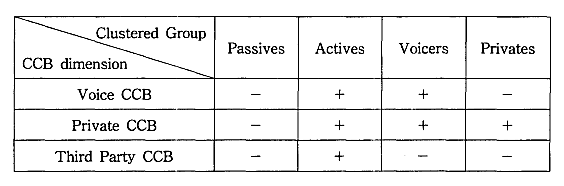
It is important for the marketers to understand the consumers' dissatisfaction respose because it can serve as the chance to recover their products' failure in the market place and to prevent potential problems arising in the future. To understand the complete feature of the CCB(Consumer Complaint Behavoir), various approaches have been made to classify the CCB dimensions. In 1988, Singh develop the taxonomy of the full CCB responses and clarifeid the three dimensions of the CCB which was consisted of Voice CCB, Private CCB and Third Party CCB. And in 1990, he developed the typology of the consumers' dissatisfaction response style which was different from the the taxonomy of CCB although related. Based on each CCB dimension, the customers were clustered into four distinct types of passives, actives, voicers, irates. Furthemore using the psychographic varialbes (Consumer Alienation, Attitude toward Complaing), the episode-specific variables (Expectancy-Value of Complaint Consequenses, Service Category), and the demographics as the discriminator, he explained over the 55% of the total variances. So these variables can be used as the predictor for the clustered consumers on the typology.
Nowadays the coverage of the new media or the PC communication media has attained the universal access level. According to the critical mass theory of interactive media, the usage of the successful media like PC communication media will be adopted by the society at an explosive way. And the communication media would be seleced by the criteria of the evaluation of the message equivocality and the media richness in the perspective of the symbolic interactionism. Furthermore beyond the rational selection process, social influences could be exercised on the medium selection processes.
The communication itself could change in the electronic environment. The direction will be 1) to egalitainanism of the participants 2) to nonconverging solution and 3) to the alternative communicating outlet for the voiceless. In the process of the selction and communication, PC communication participants could have distinct features in the dissatisfaction reponse style and the discriminators of the complaint types.
Ⅲ. Empirical Study
A survey was conducted with an object to explore the differences in the typology of the dissatisfaction responses between users and non-users of the PC communication media. To measure the complaint intentions and other related variables, similar questionarie was distributed to both the user group and non-user group.
The dimension structure of the CCB was validated by pooling the data. The dtmensions were 1) Voice CCB 2) Private CCB 3) Third Party CCB. And by the standardized factor score of these dimemsions, respondents were clustered into four groups.
Sequential discriminant analysis shows that the demographics, phsychographic variables and episode-specific variables can explain 48.8% of total variances. And crosstab analysis shows the following differences between the users and on-users.
1) The types of dissatisfaction response style varies between the PC communication users and non-users.
2) The number of passives in the user group is greater than that of non-user group.
3) The number of voicers in user group is smaller than that of non-user group.
Furthermore the differences between the two groups were found.
1) The PC communication users feel less consumer alienation than the non-users.
2) The PC communication users tend to evaluate on the conseqenses of voice CCB more positively than the non-users.
3) The PC communication users tend to evaluate on the conseqenses of voice CCB less positively than the non-users.
4) The PC communication users tend to evaluate on the conseqenses of voice CCB less positively than the non-users.
5) The PC communication users have less difficulty in lodging a complaint to the company than the non-users.
Ⅳ. Conclusion
The result of this study suggests that the population of the consumer dissatisfaction response style vary significantly with the PC communication experience. In the user group, a greater portion of the passives and a smaller portion of the voicers are expected when compared to the non-user group. And the discriptive variables of the complaining styles might be different between the two groups. Especially, the PC communication users feel less distant from the company and evaluate their potency of complaint more highly than the non-users. So it is recommended that 'new media management strategy' should be developed by the company to facillitate electronic customer support systems.
This study has limitations in its research method. A mere comparison between the two groups by the experiece on the PC communication might not suffice the need to exclude the external influences like the degree of dissatisfaction. A more rigorous experiment design might go beyond the limitations of this research.
Key Words: Information Comunication Technology, PC Comunication Media, Electronic Communication, Electronic Customer Support Service, Consumer Complaint Behvior, Taxonomy of Consumer Complaint Behvior, Typology of Consumer Dissatisfaction Response Styles
다음 페이지로