參考文獻
(국내 문헌)
1. 金稔堤 : 소비자 행동론, 나남, 1987.
2. 서성한 : 소비자 행동론, 박영사, 1991.
3. 宋瑢燮 : 현대 소비자 행동론, 법문사, 1982.
4. 유동근 : 소비자 행동이론, 석정, 1986.
5. 이학식,안광호 : 소비자 행동 -마아케팅 전략적 접근, 법문사, 1992.
6. 崔炳龍 : 소비자 행동론, 박영사, 1992.
7. 홍성태 : 소비자 심리의 이해, 나남, 1992.
8. 이종영,강명주 : 마아케팅 조사론, 석정, 1992.
9. 실천 마아케팅 전략 엄서, 한국 마아케팅 연구원, 1989
10. 趨顯哲 : 消費者 態度 豫測을 위한 다속성 태도모델의 적용에 관한 硏究
- 小型 乘用車를 中心으로 -, 中央犬學校 博士學位論文, 1987.12.
11. 윤명숙 : 서비스 品質의 마아케팅 戰略的 활용에 관한 實證的 연구 -의료 서비스를 중심으로-, 숙명女子犬學校 博士學位論文, 1991.12.
12. 崔炳龍 : 소비자 만족,불만족에 관한 연구, 동국대학교 박사학위논문, 1986.
13. 김종구 : 아프터 서비스의 전략적 효과에 관한 연구 -가전제품을 중심으로-, 아주대학교 석사학위논문, 1993.2.
14. 김태형 : 제품구매後 소비자 태도변화 유형이 인지부조화 감소에 미치는 영향에 관한 연구, 연세대학교 석사학위논문, 1993.12
15. 金영철 : 소비자 태도와 不平행동에 관한 硏究, 韓國외국어大學校 碩土學位 論文, 1993.2.
16. 강용수 : 消資者 만족의 訣定要因에 관한 硏究, 韓國外國語大學校 碩士學位 論文, 1992.
17. 徐永敏 : 製品類型에 따른 購買後 不平處理行動에 關한 硏究, 成均館大學校 석사學位論文, 1992.6.
18. 李春伯 : 消費者의 서비스 製品 購買評價에 관한 연구 -一般製品과의 比較를 中心으로-. 서울대학교 碩士學位論文, 1986.7.
19. 吳병섭 : 消費者의 서비스질 評價에 미치는 영향要因간의 關係 硏究, 한양대학교, 碩士學位論文, 1993.6.
(국외 문헌)
1. L.G Schiffman, and L.L kanuk, Consumer Behavior,2nd ed. (Englewood Cliffs, N. J. :Prentice-Hall, Inc.,1983).
2. R.J. Martin, Jr. , Consumer Behavior(New York: Macmillan,1974) .
3. C.G.Walters, Consumer Behavior:Theory and Practice, rev. ed. (Homewood. Ill. : Irwin,1974).
4. Richard L. Oliver, "A Cognitive Model of The Antecedents and Consequences of Satisfaction Decisions" , Journal of Marketing Research,17, Nov.1980.
5. Ralph E. Anderson, "Consumer Dissatisfaction: The Effect of Disconfirmed Expectancy on Perceived Product Performance, "Journal of Marketing Research, Feb.1973
6. Terrelle G. William, "Consumer Behavior" (New York:West Publishing Company, 1982).
7. Martin Fishbein, "The Relationship Between Beliefs, Attitudes, and Behavior, in Shel Feldman(ed), Cognitive consistency, Academic, New York, 1966.
8. Gordon W.allport, "Attitudes, "in C.A.Murchison(ed.) A Handbook of Social Psychology, Clark University Press, Worcester, Ma,1935.
9. D. Krech and R. Crutchfield, Theory and Problems in Social Psychology, McGraw-Hi ll, New York, 1948.
10. Martin Fishbein, "A Behavior Theory Approach to the Relations between Beliefs about an Object and the Attitude Toward the Object, "in Martin Fishbein(ed.), Readings in Attitude theory and Measrement, Wiley,New York,1967.
11. Milton J.Rosenberg, "Cognitive Structure and Attitudinal Affect, "Journal of Abnormal and Social Psychology 53(November 1956) .
12. Arch G. Woodside, James D. Clokey, and Joan M. Combs, "Similarities and Di fferences of Generalized Brand Attitudes, Behavioral Intentions, and Reported Behavior," in Mary Jane Schlinger, ed. , Advances in Consumer Research, vol.2(Ann Arbor: Association for Consumer Research,1975) .
13. David L. Loudon, and albert J. Della Bitta, Consumer Behavior Concepts and Appl- ications,2nd ed. (New York: McGraw-Hi11 Book Company(1984).
14. Leon G.Schliffman, and Leslie Lazar Kanuk., Consumer Behavior,2nd ed (Englewood Cliffs,N,J: Prentice-Hal1, Inc.,1983).
15. Daniel Katz, "The Functional Approach to the study of Attitudes, "Public Opinion Quarterly, Vol.24(Summer,1960).
16. J.F Engel,and R.D.Blckwell,Consumer Behavior,4th ed, (Chicago:The Dryden Press,1982) .
17. I. Ajzen, and M. Fishbein, Understanding Attitude and Predicting Socia1 Behavior (Englewood Cliffs, N.J:Prentice-Hall, Inc.,1980).
18. Donald R. Lehmann, "Television Show Preference: Application of a Choice Model , "Journal of Marketing Research 8(February 1971) .
19. David L. Loudon, and Albert J. Della Bitta, Consumer Behavior-Concepts and Applecations,2nd cd. (New York: McGraw-Hill Book Company,1984).
20. Masao Naknishi and James R. Bettman, "Attitude Models Revisited: An Individual Level Analysis, "Journal of Consumer Research 1 (Dec.1974) .
21. Henry Assael, Consumer Behavior and Marketing Action,2nd ed, (Boston, Massachusetts: Kent Publishing Company,1984) .
22. Denis A. Lussier, and Richard W.01shavsky, "Task Complexity and Contingent Proceeding in Brand Choice, "Journal of Consumer Research, Vol.6 ( September 1979).
23. J. L. Freeman, D.0. Sears, and J. M. Carlsmith, Social Psychology(Englewood Cliffs,N.J:Printice-Hall,1978).
24. Alvin A. Achenbaum, "Advertising Does'nt Manipulate Consumers, "Journal of Advertising Research 12(Apri1 1972).
25. Henry Assael and George S. Day, "Attitude and Awareness as Predictors of Market Share, "Journal of Advertising Research 8( December 1968) .
26. Seymour Banks, "The Relationship Between Preference and Purchase of Brands, "Journal of Marketing 15(October 1950) .
27. George Katona, The Powerful Consumer (New York: McGraw-Hi11 Book Co.,1960) .
28. Kenneth B. Runyon, Consumer Behavior and The Practice of Marketing (Columbus, Ohio: Charles E. Merri11,1977).
29. Richard J. Luts, "Changing Brand Attitudes Through Modification of Cognitive Structures, "Journal of Consumer Research 1 (March 1975).
ABSTRACT
The Attitude Change By After Service
Hwang, Won-ill (Major in Marketing, Dept. of Business Administration, Graduate School of Business Administration, Dankook University)
Advisor : Prof. Lee, Kwang Joo
To understand the consumer's attitude-change by After Service on the post-purchase would be useful for setting up the stratege of the attitude-change deriving the re-purchase.
Therefore, the objective of this study is to examine that the After Service can make a change of overall attitude toward the product through affecting the evaluation after purchase on the product, and influences on both the intention and the action of the re-purchse.
The theoretical background of this study is based on the EB high-involved model and the multi-attribute attitude model .
And the research was conducted by the questionnaire method which is consisted of the 3 types of product, the Electronics consumer product, the Computer, and the Car.
The contents of the research in detail are as follow ;
1. The cognition of the differences among companies on After Service.
2. The expectation to the After Service before purchase.
3. The satisfaction with the After Service on the post-purchase.
4. The change of the importance to the After Service on the post-purchase.
5. The reduction of the dissatisfaction with the product by After Service.
6. The overal1 attitude-change toward the product by After Service.
7. The re-purchase intention by After service.
8. The re-purchase experience due to the After Service.
The results from this analsis are as follow ;
1. The After Service influences highly on the satisfaction and dissatisfaction with the outcome of the purchase.
2. The After Service can make a change the negative attitude toward the product to the positive one on the post-purchase.
3. If the consumer is dissatisfacted with the After Service, the attitude toward the both of the product and the company can be changed to the negative.
4. Oppositely, the After Service can overlap and reduct the dissatisfaction with the product.
5. The After Service is one of the most important attributes to the re- purchase .
The strengthen of the competiveness in the limited market needs to maintain the company's own customers who was purchasing the product, and provide the satisfaction to the consumer after purchase.
At this point, After Service can attribute to the satisfaction to the consumer, and ultimately affect to the re-purchase through the costomer's attitude-change.
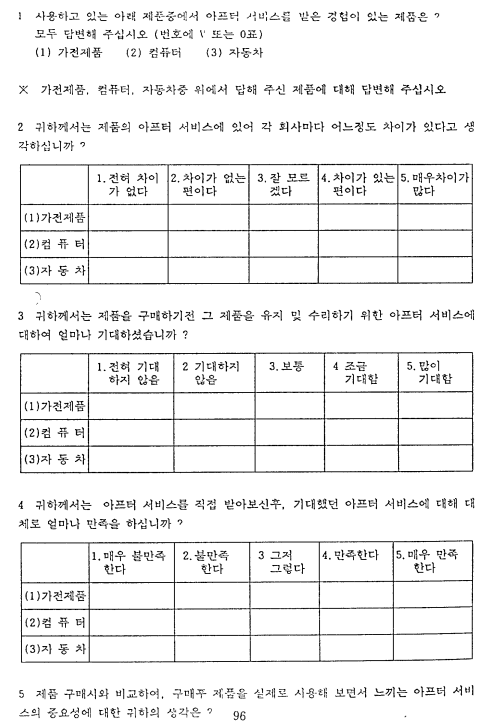
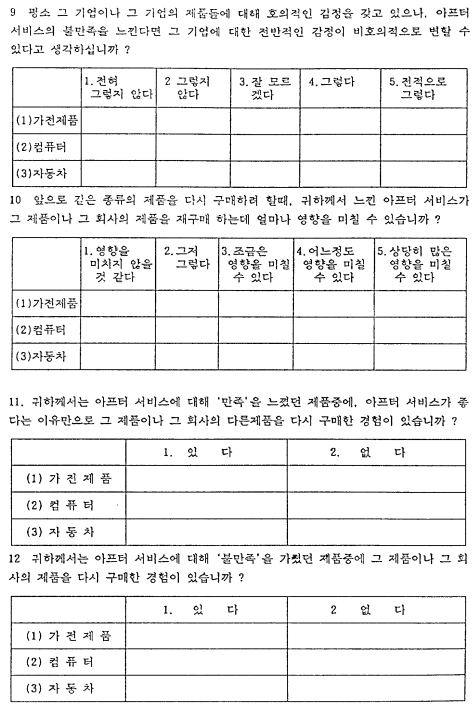
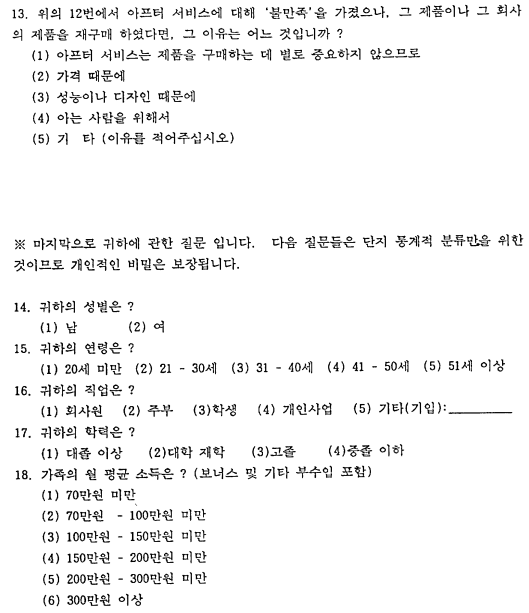
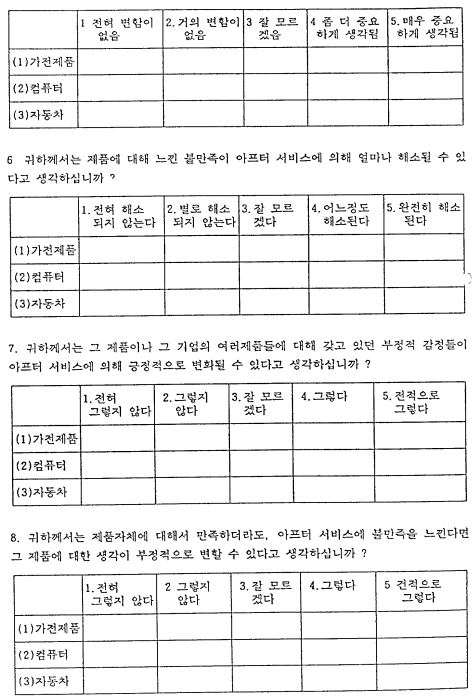
설문지
안녕하십니까 ?
저는 단국대학교 경영대학원에서 마아케팅을 전공하는 학생으로서 석사학위논문에 필요한 기초자료를 수집하기 위해 설문지를 준비하게 되었읍니다.
본 설문지는 "구매후 아프터 서비스에 의한 태도변화가 제품유형별로 어떤 유의적 차이를 보이는가